

The Globe is flat
and other discoveries I made on my trip

I flew to London last week. I wanted to research Coriolanus so I decided I needed to see the Globe Theater. The week prior I was in Slovakia. I was here also on Shakespeare scholarship. After several days there, I concluded that Shakespeare would have loved the High Tatra Mountains.
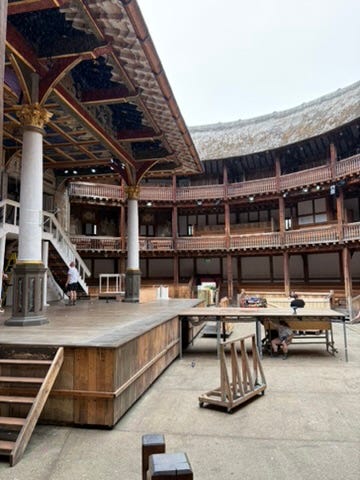
I intend to return to Slovakia and evaluate it along these lines. There are many areas Shakespeare would have enjoyed but I can’t be certain until I visit them. More importantly, it was during this research voyage I made a discovery. Pavol Országh Hviezdoslav, whom I translated for Wasted Blood, was very fond of Shakespeare!
Hviezdoslav, which is a self-given surname meaning something like, one who celebrates the stars, translated both Midsummer’s Night Dream and Hamlet.
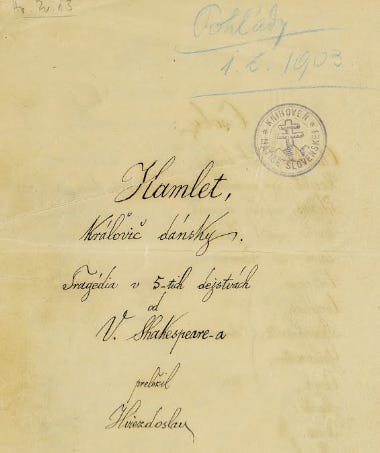
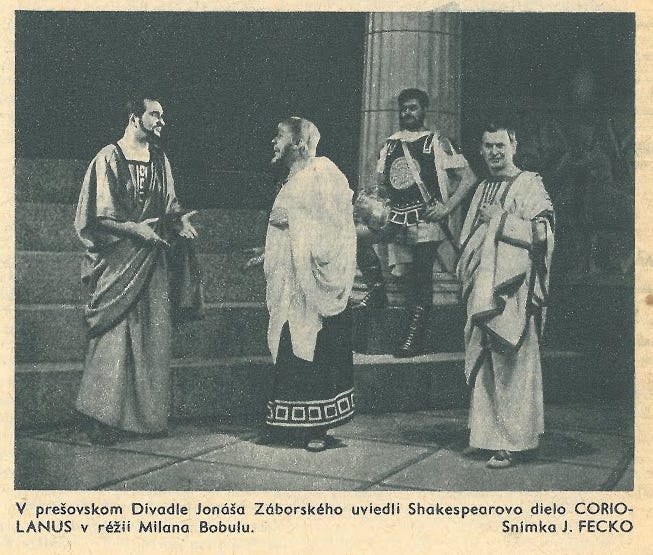
Coriolanus did not make it to the Slovak stage apparently until the 1970s. It received praise in a review for the mirror it held up to political society at the time, under socialism. The uncomfortable questions of Coriolanus continue to bubble to the surface. How much power should the people have in government? What becomes of military men when society decides to have no need of them? Who deserves our greater loyalty, our families or our countries? These questions drive me to produce this play.
In the tour of the Globe I also learned a few things that shocked me. The first was that since there were no bathrooms, it was perfectly normal to just defecate where you stand. If you paid extra to have a seat, there was bucket that was passed around.
But readers, that was not the most shocking fact! I was informed that the idiom of the day was not, “we are going to see a play” but “we are going to hear a play!” These productions were an audio-first enterprise! The most expensive seats were behind the stage and to the side. Both of which had the worst views but the best acoustics. Sound effects were crude by creative. Such as rolling a canon ball on the roof to simulate thunder.
The play existed in the theatre of the mind first. As our culture became more visually obsessed, somewhere the language changed to “wanting to see a play.”
Friends, with this audio production we are bringing back an oral tradition that is in some sense, closer to what Shakespeare himself did! After my discoveries about this audio tradition and about Hviezdoslav’s connection to Shakespeare, I returned home with more energy for Coriolanus.fm that when I left!
I had many other adventures over these last few weeks but I you, readers, for your patiences as my film is in the queue for processing. But rest assured, I met many friends, and had long conversations over drinks and food. I wish to return to the play as soon as possible but I’m struggling hard over some jet lag. Which, you may now enjoy this jet lag poem I wrote last time I returned from Europe:
Traveling starts after we arrive
as we rundrivewaitflyrunwaitflyride.
My body arrives where east is west and day is night
and the hands of time spill sand
s l o pp il y
like a drunken clock.

Sleepwalking through a noon sunset, I await my soul —
sailing across the strolling sea
sipping his tea —
in no hurry to rejoin with me.
The cast is nearly set for Act 1 and I will be sending the script shortly, if I can get some sleep.
Ah, but there is one last thing I want to mention!
As it is still Analog August, where we celebrate analog media, I also visited The British Library where I saw this:
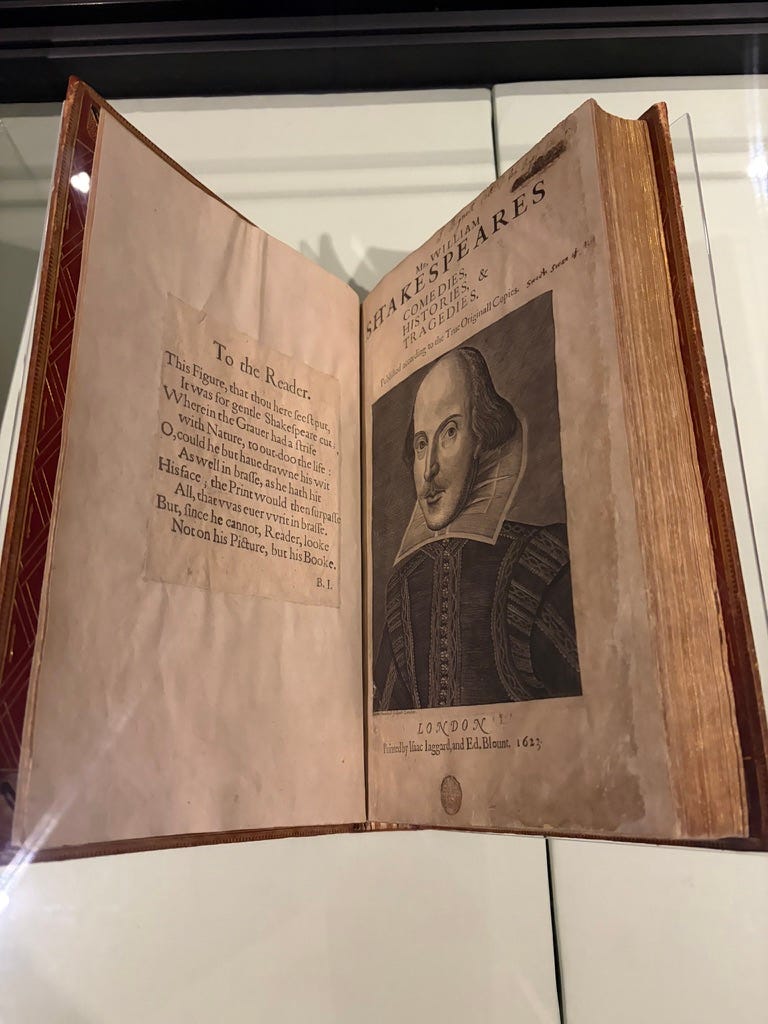
The above book is known as the First Folio, published in 1623, seven years after Shakespeare’s death. A few hundred copies were made this book is the reason we are performing Coriolanus and the reason some of his most important work survived.
If Shakespeare had a Substack, his work would have been lost forever.
Any author’s Substack is but one database entry from being completely erased. There’s that saying, the internet is forever. But this is only true for data that people care to copy, such as memes proving that that the internet is forever. If no one copies your data, it is ephemeral. Just like Shakespeare’s plays while he produced them.
If Substack is down, everyone’s articles, poems, stories are inaccessible. The same thing happens when Netflix pulls a shows. It simply disappears. Digital data occupies physical bits. Yes, transistors grow ever smaller but this article exists in a server somewhere. It exists in RAM on your computer or phone as you read this. And then, poof, it is gone.
As any tech nerd or computer hobbyist about backups and you soon realize how easy it is to loose digital data. Perhaps you have lost data yourself. And someone, we are all to happy to trust these digital platforms with it.
But it’s more than that. Justin Patrick Moore writes:
It used to be that when I took a piece of music to review, you’d be sent a physical copy. That still happens, but it is a total rarity, its the exception, not the rule. Sometimes record labels don’t even send the reviewer a download. Just a link to a place where the music can be streamed. I feel less of a connection to the artist and the label this way. When physical copies were given in exchange for the words spilled about music, there was at least some more incentive because the labels know that most of the people who take this up are big music fans and collecting records anyway.
Digital content is so convenient, we forget why we are sharing it in the first place. It rewards speed and frictionless experiences. Justin could previously look back at his record collection and remember ah, I reviewed this record. When everything is digital, all he can do is look at a dead hard drive in the hopes he can revive it.
I’ve already experienced an excellent writer who disappeared. Almost two years ago, Keith Hill was writing here on substack in a brilliant way. Then one day. Poof. His entire account was gone. There is no trace.
From many of you I have zines and postcards. It is a wonderful collection of handwritten personality.
We are but a third of the way through Analog August but these are the kind of questions I hope to encourage. Are we making only memories in each others minds or is there a physical artifact that anchors that awareness?
So, Let me know how your Analog August is going below! Hopefully we can share ideas and inspire each other to create objects of lasting beauty. And stay tuned as we kick of Act 1.
Lovely article as always and you make me reflect on my presence outside of Substack and the physical nature I would like to leave. On the first point, I obviously just need to do the heavy lifting and finally buy a domain to start a website, which is just when I get the time. On the second, I've been thinking of doing something similar to what Whitman did with Leaves of Grass. Publish my works as seen here and then over time continually add to the physical copy, versus the traditional route of publishing based on a theme.
Once again, thanks for the push either way.
We were so close to meeting, I was in Luton this weekend for a wedding.