

War Girls
War erasure #6 to a lune

Welcome to War Erasures, where I take a Banksy-like spray can to war propaganda poems. On the street corner today is War Girls, by Jessie Pope written in 1916.
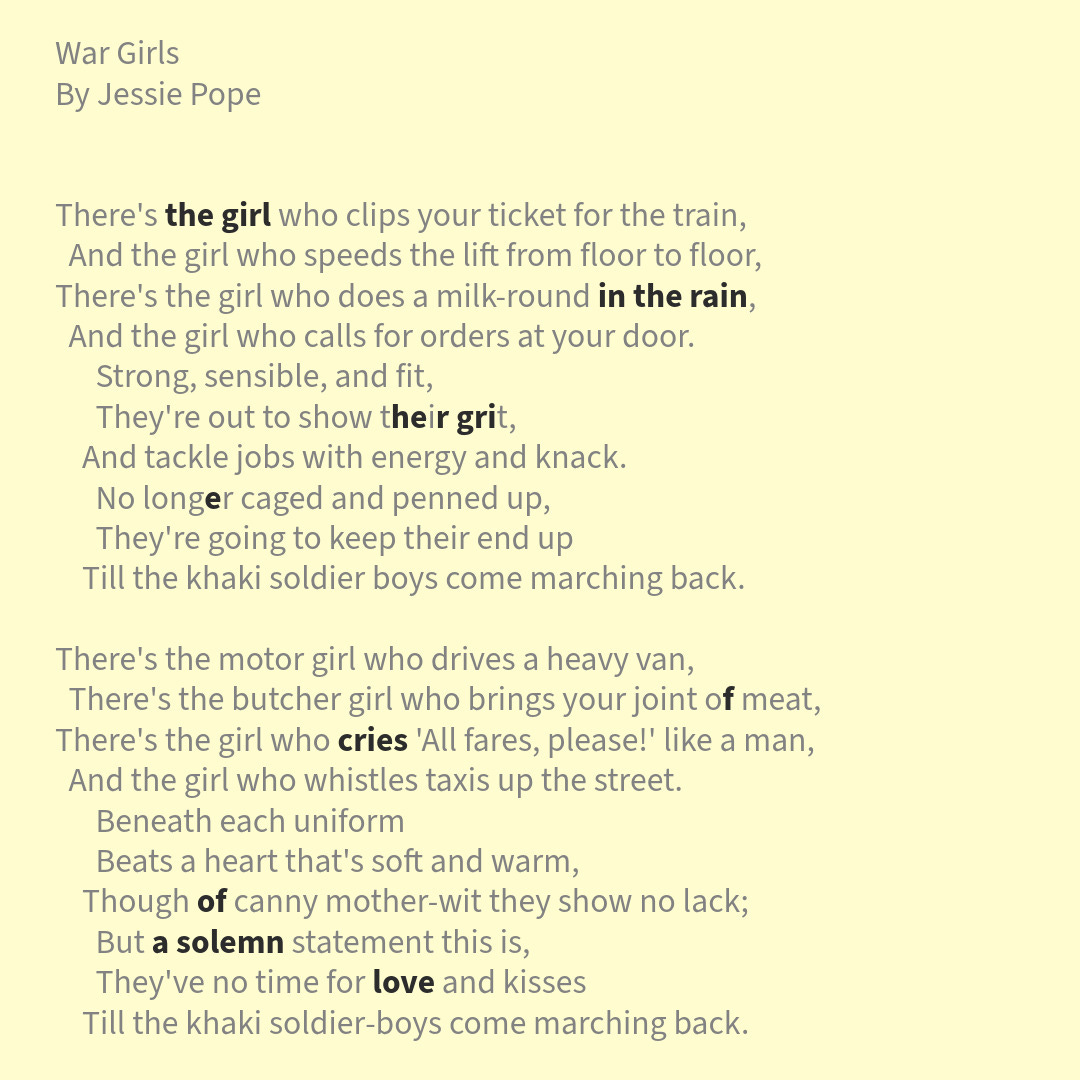
The girl in the rain,
     her grief cries
of a solemn love.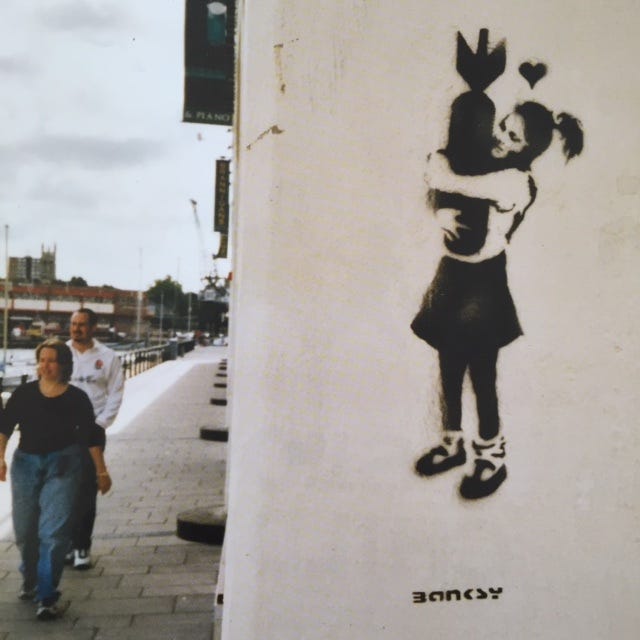
In retrospect, it is easy to dismiss Jessie Pope’s poetry as being naive. But I must remind you, a war only becomes pointless once the next war starts. During the war effort, Pope’s poetry was reflecting the official message of the time. Take a look at this British propaganda poster from March, 1915.
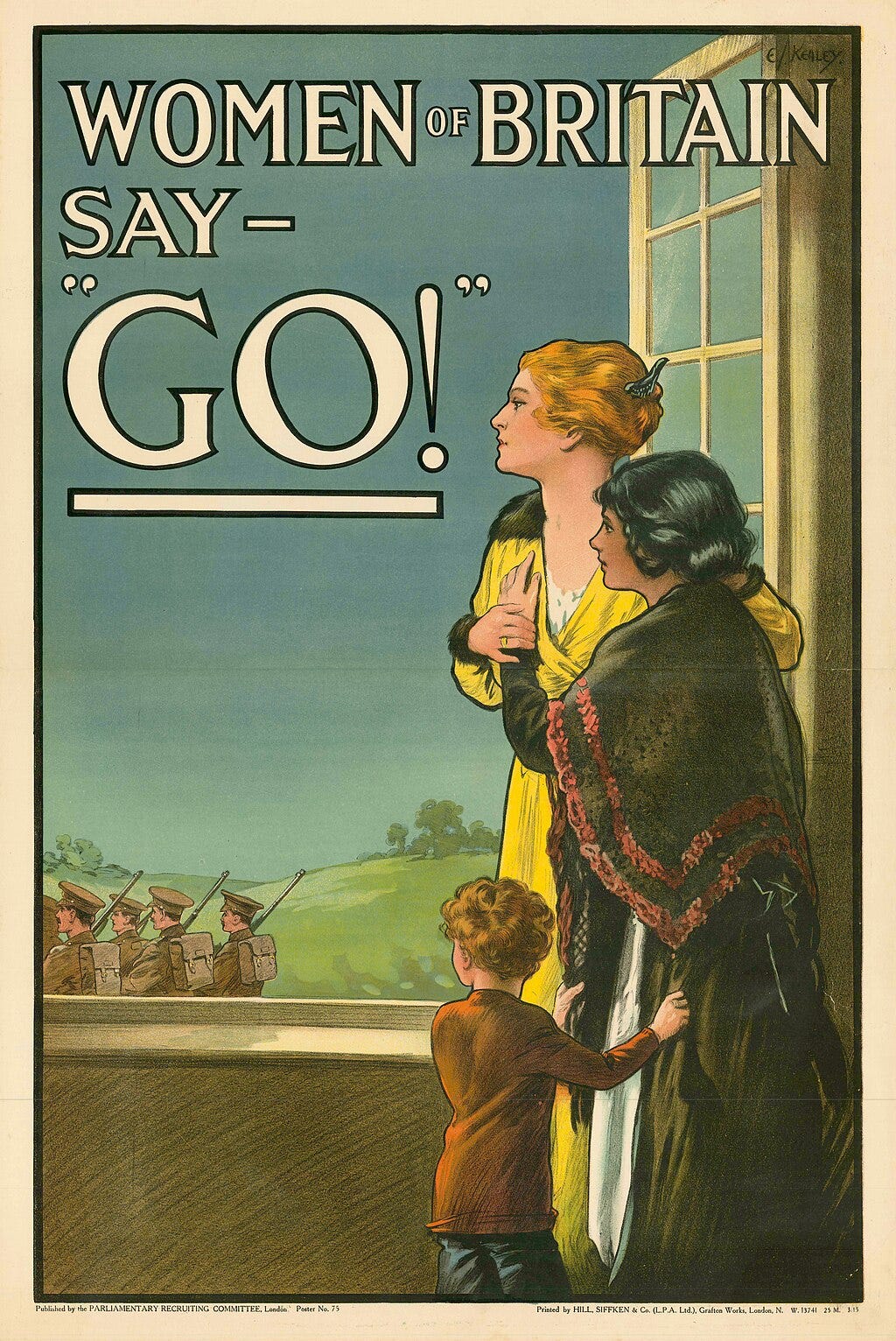
I think the girl in Bomb Love and the orange-haired woman in the poster — they both have a proud look to them. The bomb and the solider could be swapped in either picture to the same effect.
War does not just effect the solider. At least each solider has a mother, possibly a spouse and children. I have not seen this torment better described in poetry than in The Bloody Sonnets. Here is Sonnet 16 which I translated, and it also appears in my upcoming collection, Wasted Blood.
Clouds of collected souls roll
     over a house.
In this home sits a grandfather —
     now the caretaker of a
     fractured family.
At his feet an old woman sits
     like a hen,

wrapping her arms around
     her grandchildren.
Each one sobbing as they
     stare into the stars.
In the kitchen,
     a newly widowed wife —
          unaware.
With wet eyes,
     she joins them by the fire.

And in the orchard,
     all alone,
     the daughter.
Heart yearning for her brother
     who also went with a
     bold mind to
          the reaping fields,
where the scythe is sharpened,
     daily,
     with a wet stone —
     fresh with the morning
          dew of blood.
Who will answer for
      these sufferers?
What can be said to these faces
     filled with tears
     and sorrowful loss?
I chose War Girls because the families of veterans are often not considered, when dealing with war. Unsurprisingly, the American military has higher rates of domestic abuse than its civilian counterpart. But a recent change has caused an increase in convictions once domestic abuse cases were forced to be handled outside the military change of command according to Military.com:
The shift comes after years of fights in Congress, with advocates insisting that crimes were being overlooked, and opponents arguing that potential changes would undermine commanders, culminating in a revamping of the system passed by lawmakers as part of an annual defense policy bill in 2022.
I remember at the Naval Academy watching The Great Santani with Robert Duvall. We discussed how much military life should mix with family life. While there are plenty of successful military families, there are unique challenges.
However, this does not compare to the following paragraph from a review of the book, The Fort Bragg Cartel. I have bought this book, but I have hardly made it past the first few chapters. It documents the violence and drug addiction that soldiers, in this case, special operations soldiers, bring home to their families:
The most affecting parts of The Fort Bragg Cartel are the vignettes Harp collects showing the devastation soldiers inflict on their families: an operator named Keith Lewis beat his wife, then pointed a gun at the cops who showed up when she called. No charges were filed, and soon thereafter he was promoted. A couple of years later, Lewis murdered his wife, who was pregnant, with a gun in one hand and their daughter in the other. Another operator stomped to death his tiny dog, named Greta Bean, then shot his wife in the head before killing himself. This didn’t start recently. In July 2002, the Times was reporting a “growing problem” at Bragg: soldiers murdering their wives. The report notes that of the four women killed in the six weeks before the article was published, three of the victims were married to men in the special forces. One, another who killed his wife and then shot himself, was a member of Delta.
This is why the sixteenth sonnet calls to me. The families with deployed soldiers, if they get them back alive, who comes back? No one suffers alone. A family, a community, they bare the burden too. I don’t wish for more state-sponsored military holidays, but the war doesn’t stay overseas.
The wives of these men did not volunteer in the army, but they paid a high price for their service.
This girl in the rain, perhaps she has a solider who did return, but no longer is the same.
The girl in the rain,
     her grief cries
of a solemn love.
I knew about the murders. Doesn't make it any easier to read about it again.
Concurring with Daniel V. Gaglio - excellent poem and post.
WIshing that Substack provided us with something other than a heart to commend work like this.
I love to read your work, but this is heartbreaking. Yet perhaps if we allowed ourselves to be more broken hearted, we'd be less hard hearted. The former allows for healing, while the latter encourages turning a blind eye.
I saw this book you speak of at work, but hadn't heard about it again. Ignoring these things doesn't make them go away. Thank you for turning bravely towards them.