


Siegfried Sassoon is one of my favorite anti-war WWI poets. But in this poem, he takes a sarcastic tone so I shall play with it for the erasure.
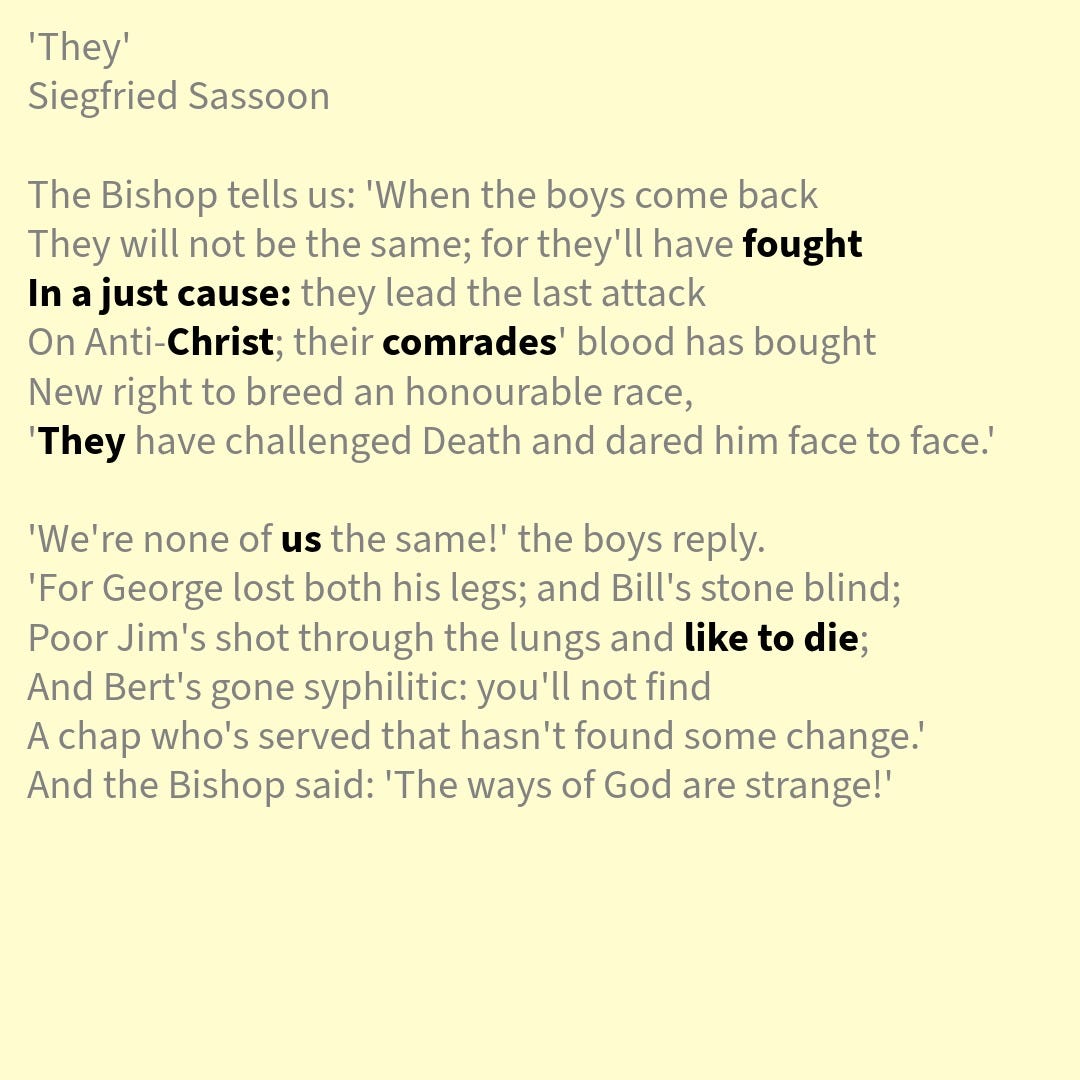
Fought in a just cause:
Christ comrades.
They, us, like to die.
There is a theory of war, called Just War Theory. At best case, it’s a framework for deciding when war is morally justified. At worse case, it is a slogan adopted by the United States. Maybe not officially adopted, but by their actions, indeed.
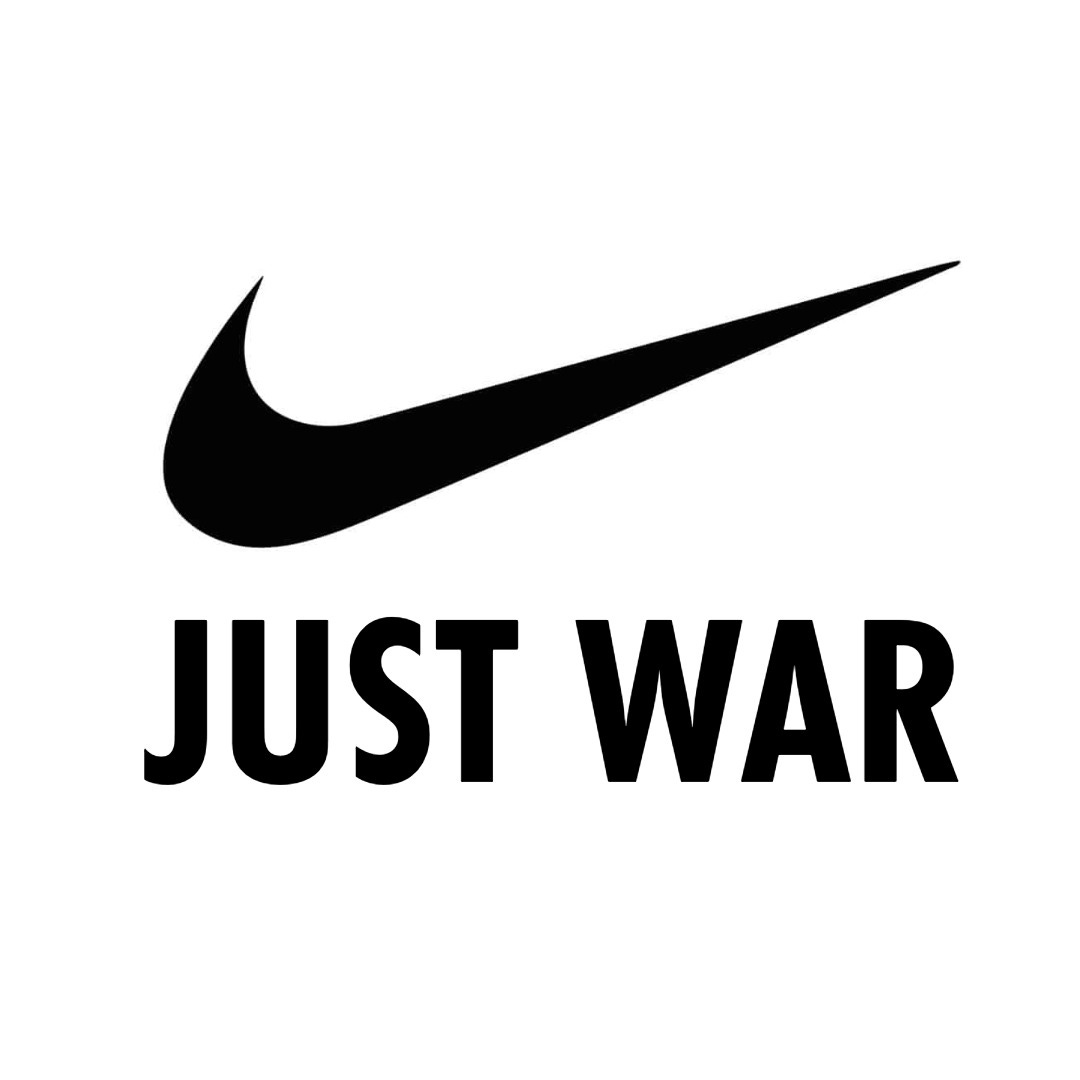
And I don’t really want to get into the theory, because ultimately, it is a framework for those that want to justify war for those that want to wage it. However, I shall set my cynicism aside briefly to summarize it.
The theories have their roots in Catholicism and Christian ethicists going back to St. Augustine in 350ish and St. Thomas Aquinas in 1225ish. One of the theological questions under consideration was can members of the church go to war?
Several requirements developed from the framework, which is like a checklist to go to war. For example, one of them is this: is going to war the last resort? Have all other means been exhausted?
The President of the United States thought so in Iran. The President of Russia also thought so when he ordered the invasion of Ukraine. Both of these men make at least lip service to their respective forms of Christianity.
The problem with the Bible and other holy texts, is we can’t decide if they to be taken literally or metaphorically. Is the eucharist the body of christ or a symbol? This is why I quite like Robert Charboneau ‘s techno-poetic Scroll series. He starts part four with:
As it was written, so is it literal.
Of course, the Bible has been used for all sorts of justifications. The most recent is the war in Iran.
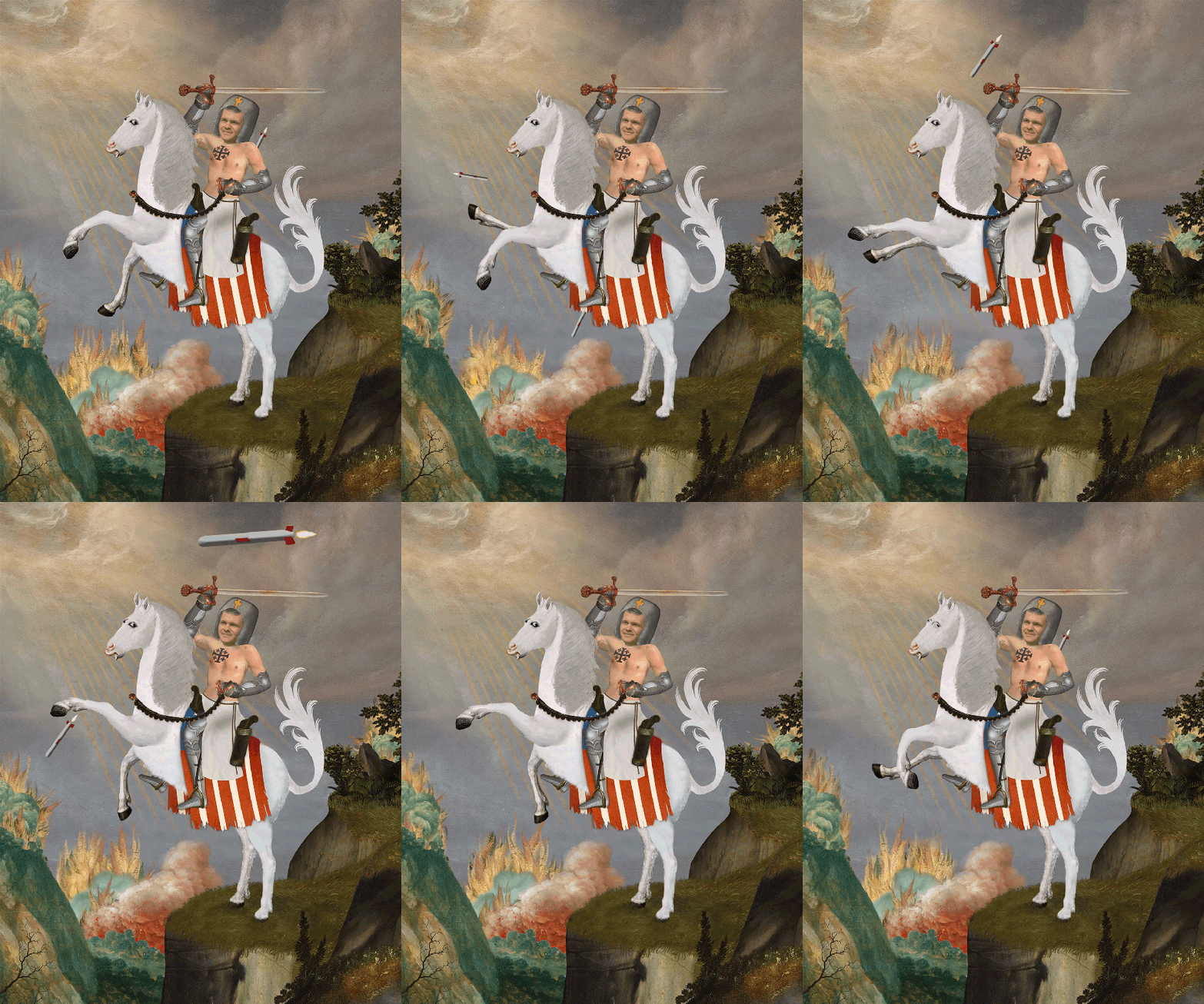
Citing a verse from Matthew 10, Potteiger [Brooks Potteiger, Hegseth’s closest spiritual adviser] told the gathered leaders of the US military: “If our Lord is sovereign even over the sparrow’s fallings, you can be assured that he is sovereign over everything else that falls in this world, including Tomahawk and Minuteman missiles …
“Jesus has the final say over all of it.”
In the same Guardian article as the above quote, they captured this sentiment in gif form:
But why go through all this justification anyway? Why not just say, we wanted to attack Iran, we knew we could attack Iran, and so we did. Clearly no one, neither the U.S. legislative branch, the judicial branch, the United Nations, nor NATO is stopping this behavior, so why not just “own it” ?
Well, justification aids in the rationalization of killing. And war is rationalized, state-sanctioned murder.
In the book, On Killing by Lt. Col. Dave Grossman, a book which was once on the reading lists of Quakers and the United States Marine Corps, there is a flow chart, which I present below:
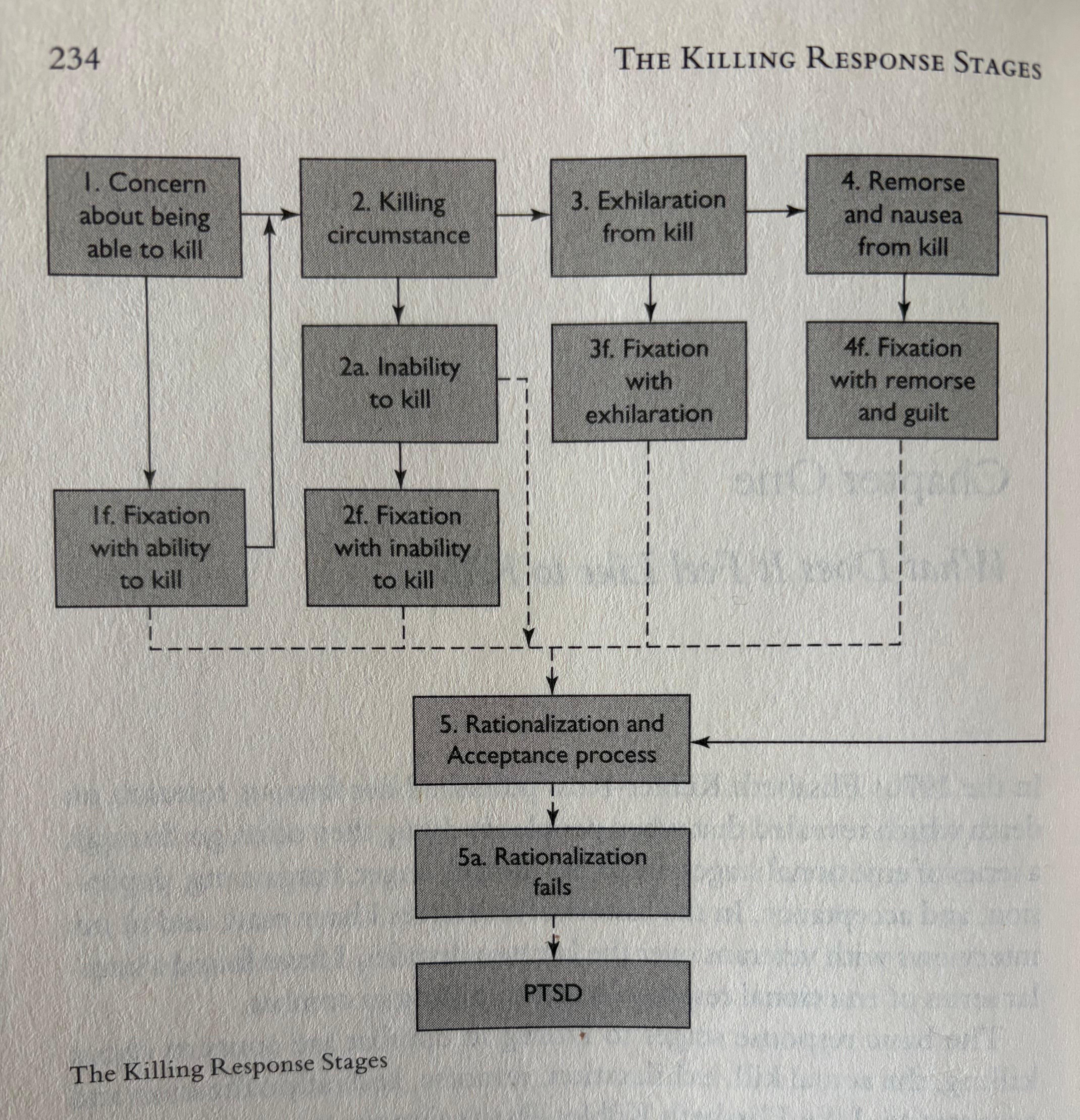
There are several takeaways one could get from this graph. But the one that stands out to me is: if you fail to rationalization killing, you will get PTSD. The corollary then is this: rationalize killing to avoid PTSD.
So when your church and state are aligned to justify a war, it certainly helps keep a clear conscience. That is, if you believe in the state and/or the church. Both of which now seem to require leaps of faith.
One of my falling-outs with American lower-case-christianity, was during the GWOT when at Sunday service, we’d be praying to keep our soldiers safe and praying for our leaders to make wise decisions. Then we soldier-on in Afghanistan. My faith in the state was weak, so I failed to rationalize the killing I saw around me. Forgive me Father, for I have sinned.
If you are a devout Catholic in the U.S. military now, frankly I am not sure how you are squaring-the-circle between the social-media beef between the pope and the American military leadership. Maybe your military chaplain can help you justify this just war.
Anyway, On Killing neatly summarizes this psychology problem of killing-guilt. The problem is that most humans struggle with killing other humans. So, how to deal with this in the military where the job description is to kill other humans?
But the problem is that the military does not want to simply return the psychiatric casualty to normal life, it wants to return him to combat! And he is understandably reluctant to go. […] But if soldiers begin to realize that insane soldiers are being evacuated, the number of psychiatric casualties will increase dramatically.
If this sounds familiar, it is because it is the core definition of Joseph Heller’s Catch-22. In that novel, Yossarian realized he could leave WWII if he was determined crazy. It is crazy to get into plane and fly into enemy territory. But to recognize this as crazy, is proof that one is indeed, sane.
Catch-22 is a bit juvenile perhaps. But I only see myself in Yossarian. If your faith in the state is on shaky ground, there is no way to make sense of a war. It is comically absurd to those that are forced in that theater.
My wife doesn’t like it when I read On Killing in bed. The cover has a picture of that million-mile stare of a shell-shocked solider. So I save that book for performative coffee-shop readings. At night now, I take up, The Fog of Peace: How to Prevent War, by Gabrielle Rifkind and Giandomenico Picco.
I discovered this book from the following substack post, in which Gabrielle appeared.

In the preface of this book there is a epigraph from the poet Rumi. Poetry speaks the word that many fail to find. On the question of have we exhausted all options before we wage war, Rumi, as always, provides some ancient wisdom. I would like to see this added to the requirements of a just war.
Out beyond ideas of wrongdoing and right doing, there is a field. I’ll meet you there.
Josh your romance of the bugle and extended series on war poetry has given me an epiphany which, whether deserved or desired, I will pass on to you. You probably have heard of the Shofar, the rams horn blown during the Jewish High Holy Days of Rosh Hashanah (the New Year) and at the end of Yom Kippur (Day of Atonement). Now, in accordance with the Torah, what most religious western adherents refer to as “The Old Testament,” all of Israel’s wars in biblical times were just. The current American and Israeli administrations evidently agree that this also applies to the current epoch. Now the Shofar is blown in rigidly prescribed intervals, much as our present trumpet at reveille or retreat. It is blown weeks before Rosh Hashanah except for the day preceding Rosh Hashanah. While the timing and rhythm varies depending on the day, it is usually blown in multiple blasts. It seems to me that the interval between blasts is opportune for jazz rifs. This would not only ennoble the sound but give added meaning to the solemnity of the moment. Interested?
This one has some of your most powerful prose... though I thought the erasure was powerful as well in its compact impact. Perhaps part of it is the way I wrestle with my own Christian upbringing ... and what I see as the mockery of that faith by Hegseth and Trump... Glad you found the Fog of Peace book. It's good to keep your wife happy. Some peace right there.
I am trying to think of a way I can use something from the TV show Justified in the same way as the Nike symbol here... but it might not fly in the same way.
My late uncle came back from Vietnam and promptly went schizophrenic. He might have otherwise, because there is a history in the family. But it was my great uncle who also had it on that side of my family and he was in WWII.
For some reason, loading bodies up onto stretchers while tripping balls on LSD, which my uncle did in Vietnam, doesn't seem like a good recipe for avoiding unwanted mental health outcomes.
Peace to you Josh.