

Into the deep
Submarine poetry

In 20,000 Leagues Under the Sea, Jules Verne wrote in 1870:
The globe began with sea, so to speak; and who knows if it will not end with it? In it is supreme tranquillity. The sea does not belong to despots. Upon its surface men can still exercise unjust laws, fight, tear one another to pieces, and be carried away with terrestrial horrors. But at thirty feet below its level, their reign ceases, their influence is quenched, and their power disappears. Ah! sir, live—live in the bosom of the waters! There only is independence! There I recognise no masters! There I am free!”
I once lived under the sea. I served as a Submarine Officer from 2002 - 2012. Most of my writing here is shaped by my brief time in Afghanistan in 2011. But much of the soul-pain I received from Afghanistan is because of how much I enjoyed my time at sea on a submarine.
It is a spaceship that travels underwater. Elon Musk dreams of Mars — but the sea is King of the Earth. It remains largely unexplored and unconquered. Most good sailors have a deathly respect for the sea. As Admiral Arleigh Burke said:
Neither timid nor reckless men should go to sea.
Through poetry and history I will now briefly explore the submarine and add my own poem to the deep.
There are few submarine poems out there. Rudyard Kipling wrote of them. In WWI, the world witnesses the destructive terror of the submarine for the first time. Here is Kipling’s Tin Fish:
The ships destroy us above
    And ensnare us beneath.
We arise, we lie down, and we move
    In the belly of Death.

The ships have a thousand eyes
    To mark where we come . . .
But the mirth of a seaport dies
    When our blow gets home.
The ellipsis here are thought to be intentional, symbolizing the path of a torpedo. The submarine, or U-boat, in WWI was a tremendous shock to the world. It was a weapon only dreamed about by the likes of Jules Verne before the war.
The RMS Lusitania was a British luxury ocean liner. Just take a look at its own marketing material for the ship from the first class dining room:
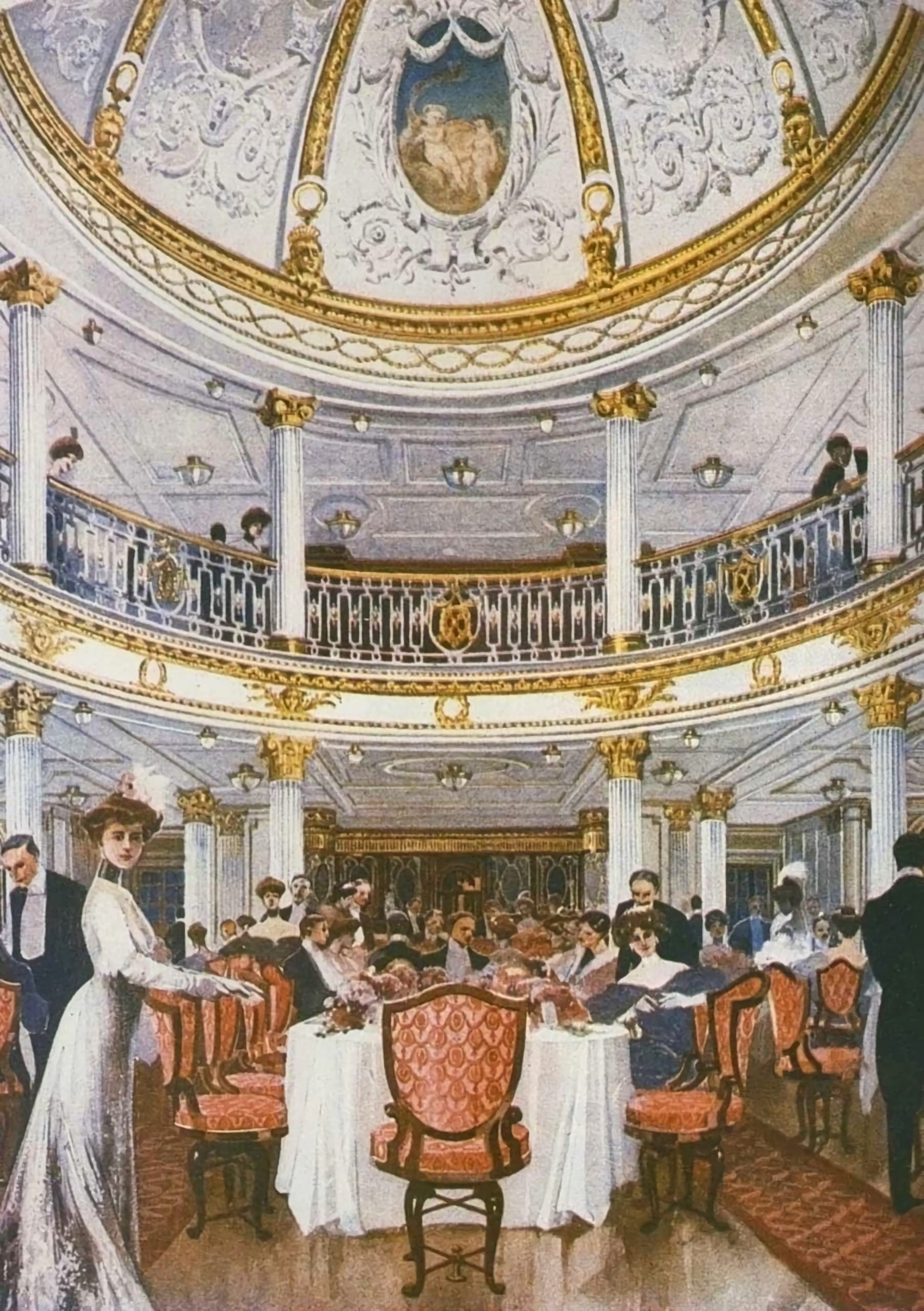
On 7 May, 1915, she was sunk by the German U-boat U-20. Over 1,200 civilians died in the sea off the coast of Ireland. The next day, The New York Times runs this on the front page:
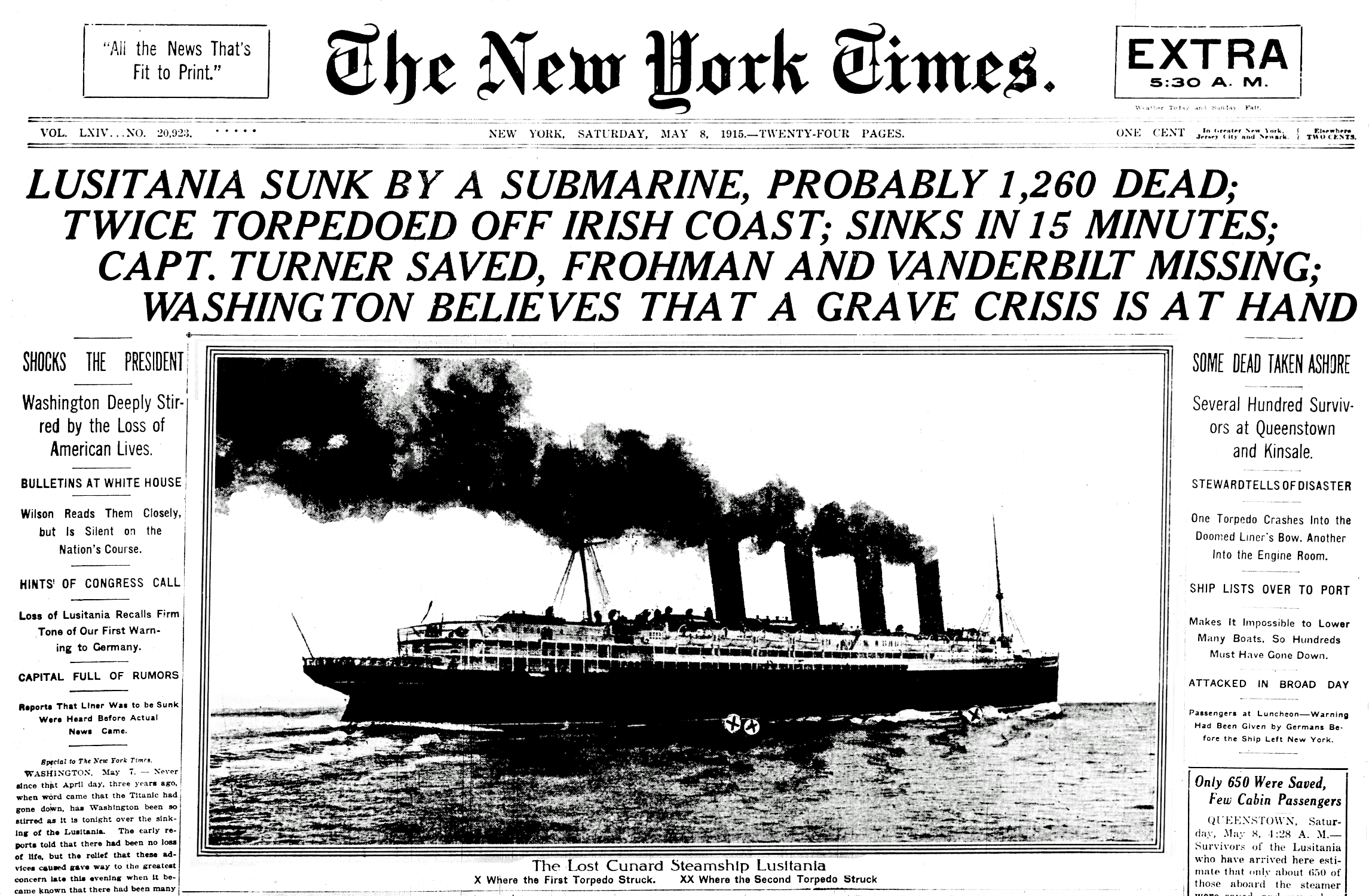
This sinking was a contributing factor for American support in WWI as there were American citizens on the ship. However, there are some inconvenient facts about this incident. Mainly, that the Lusitania was carrying military munitions.
There continues to be a mystery about this sinking as a single torpedo sunk this entire ship in 18 minutes. Even the U-boat commander was shocked, since a second explosion was noticed after the torpedo hit. What caused this second explosion? Was it even more raw explosive material not listed on the manifest? Or was it simply the result of the continued explosion of the boiler? Neptune is the keeper of secrets.
The book Dead Wake by Erik Larson, 2015, and the NYT review, suggests the shock of Lusitania was perhaps manufactured.
Shortly before the disaster, Churchill [first lord of the Admiralty] had written in a confidential letter that it was “most important to attract neutral shipping to our shores, in the hopes especially of embroiling the United States with Germany.” Afterward, he all but celebrated the sinking as a great Allied victory, saying, “The poor babies who perished in the ocean struck a blow at German power more deadly than could have been achieved by the sacrifice of a hundred thousand fighting men.”
And continues:
the British Admiralty apparently had a very good idea of [the submarine] whereabouts in the days leading up to the sinking — and yet did nothing. Encryption experts working with the Admiralty’s Room 40 regularly intercepted Schwieger’s [the U-boot commander] transmissions and closely followed his movements around the British Isles. “It was a curious moment in the history of naval warfare,” Larson writes. “Room 40 knew a U-boat was heading south to Liverpool — knew the boat’s history; knew that it was now somewhere in the North Atlantic under orders to sink troop transports and any other British vessel it encountered; and knew as well that the submarine was armed with enough shells and torpedoes to sink a dozen ships. It was like knowing that a particular killer was loose on the streets of London, armed with a particular weapon, and certain to strike in a particular neighborhood within the next few days, the only unknown being exactly when.”
Regardless, it was the submarine the shook the world on May 7th, 1915. As with every new war, technological progress rewrites the rules. Terror from the deep was no longer limited to sharks and squids.
President Jimmy Carter, a fellow alum from the U.S. Naval Academy and fellow Submariner, wrote the following poem, also dealing with the killer nature of submarines.
Life on a Killer Submarine
	by President Jimmy Carter
		(published in North Dakota Quarterly, 60:1, 1992)


I had a warm, sequestered feeling
deep beneath the sea,
moving silently, assessing
what we heard from far away
because we ran so quietly ourselves,
walking always in our stocking feet.
We'd often hear the wild sea sounds.
the scratch of shrimp, the bowhead's moan,
the tantalizing songs of humpback whales.
We strained to hear all other things
letting ocean lenses bring to us
the pulse of screws like a heartbeat,
the murmurs of most distant ships,
or submarines that might be there and hunting us.
One time we heard, with perfect clarity,
a vessel's pulse four hundred miles away
and remembered that, in spite of everything
we did to keep our sounds suppressed,
the gradient sea could focus, too, our muffled noise,
could let the other listeners know
where their torpedoes might be aimed.
We wanted them to understand
that we could always hear them first
and, knowing, be inclined to share
our love of solitude, our fear
that one move, threatening or wrong,
could cost the peace we yearned to keep
and kill our hopes that they were thrilled like us
to hear the same whale's song.
Among the whale’s song, killers lurk in silence.
When I was on a submarine, at times, it was like what Jules Verne wrote. I was alone under the water, like President Carter describes. I have been thinking about how to write my own submarine poem for some time. But I will credit Ann Collins for pulling this out of me, who said yesterday that she would like to hear poetic submarines. So Ann, this one is for you.
Into the deep
I stand atop the sea, and submerge into my soul.
One last look at lunar light before I dive under the trough of waves.

Down,
           I go into the dark,
           through the thermocline of youth.
Down,
           in eternal descent,
down,
           deeper than Dante,
down,
           where no else can go,
           but me.

Shadow submarines sail among the shipwrecks of self.
Are these blind hunters friend or foe?

These ghosts of the deep welcome me, for they know my song.
Join us again, return to the sunless life!
I swallow these steel fish and climb to the top of the sea.
Edit: I changed ‘sound’ to ‘song’ in the last stanza, which occurred to me while I was in the shower. Water has a way of bringing such things out, especially in poems about water.
This piece really made me think about how we find independence and peace. The way you describe the sea's profound tranquillity reminds me of the mental space I get during Pilates. It's like finding a deeper core, away from the surface noise. Your insights on the unexplored are truly beautifull.
I had no idea that President Carter was a poet