

Beat! Beat! Drums!
Graffiti over Whitman

I depart from WWI to take my spray paint can over Walt Whitman for this erasure.
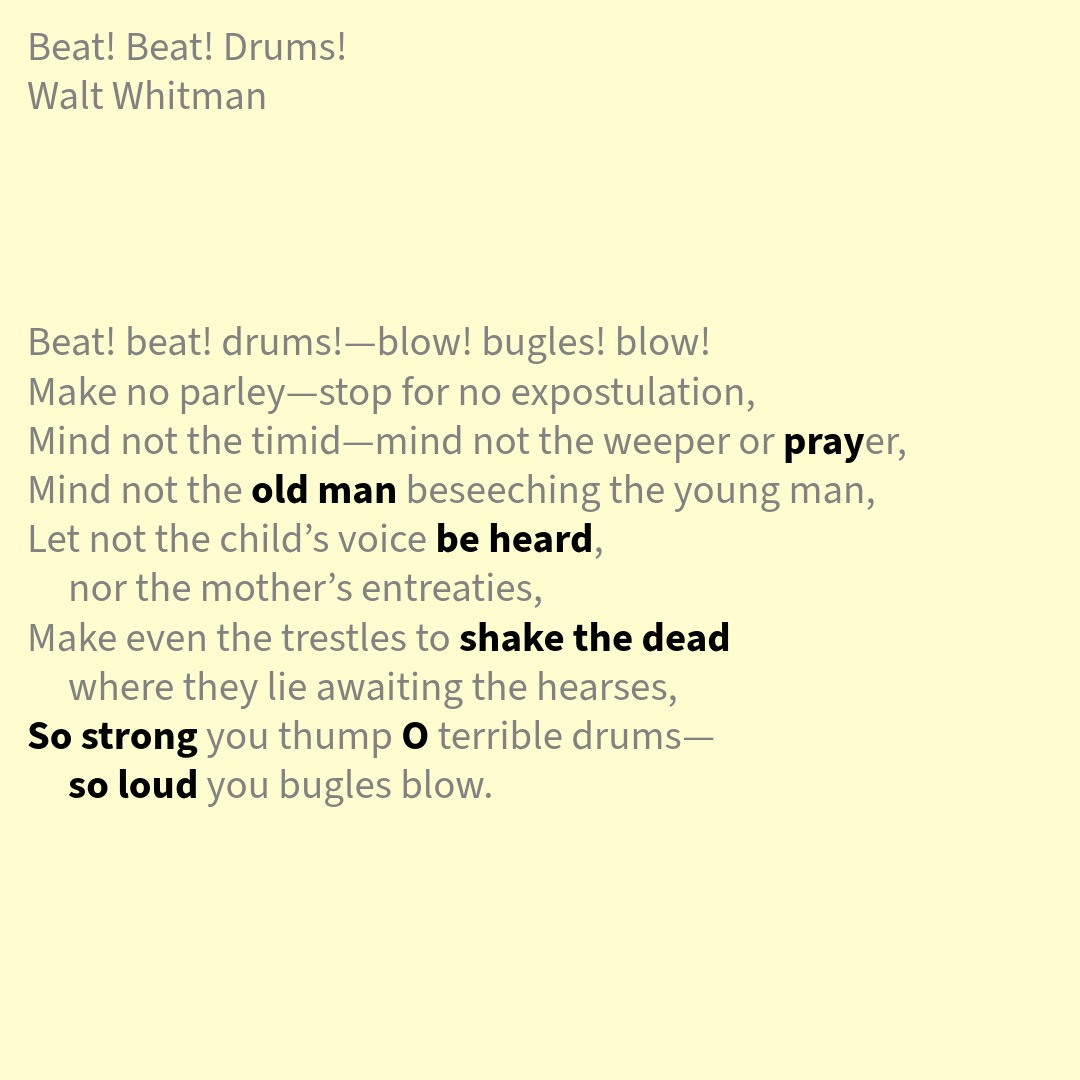
Pray old man, be heard!
     Shake the dead!
So strong, O so loud.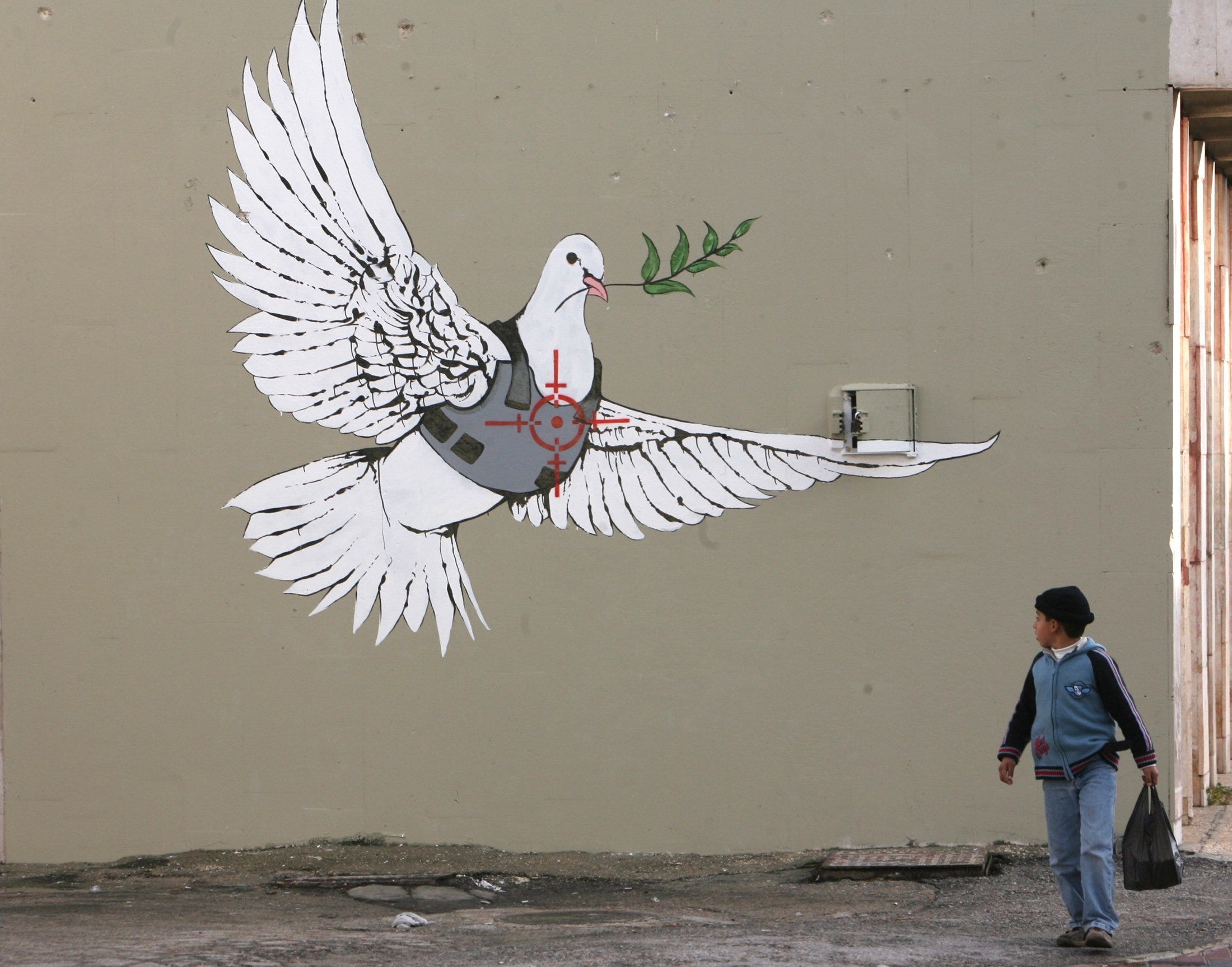
I’m getting pissed at poets. Whitman wrote this poem in 1861 after the battle of Bull Run, in which a Confederate victory showed the Union that, unsurprisingly, that the war would not be short, nor easy. A lesson the United States continues to never learn.
The Whitman encyclopedia has this to say in its entry of this poem:
The poem depicts peacetime scenes being dashed aside by the frenzy of war. Despite its overt bellicosity, many scholars have detected signs of thematic ambivalence: in the speaker's persistent questions; in the protests of the peace-loving (e.g., the old man, the child, and the mother in stanza three); and in Whitman himself, for whom the war and its totalizing structures were an unwelcome but necessary means of redeeming a divided and increasingly materialistic democracy.
Unwelcome, but necessary.
In this sense, Whitman joins W.B. Yeats for me whose arrogance of the war frustrates me to no end. How can both poets, seemingly be so connected to natural beauty have such attitudes to war? Robert Charboneau may have an answer for us when he writes:
[…] poets make stuff up. It’s true, yet it’s a truth rarely repeated. We often forget what it means that the poet is first and foremost a Maker. Those who forget most often are the poets themselves.
Poets are gifted with certain powers of language, endowed with gifts of imaginative creation. The poet believes himself to be in possession of an ability to communicate with the divine, within or without, and to speak truth as a matter of fact. But Plato knew that poets are not truthtellers by nature. They are makers, but not always makers of truth.
At least Yeats, in his WWI poems, maintains a kind of indifference, unlike Whitman here who is beating the drums of war while staying in the rear. This all reminds me of Elegy in a Country Churchyard by G.K. Chesterton:
The men that worked for England
They have their graves at home:
And birds and bees of England
About the cross can roam.

But they that fought for England,
Following a falling star,
Alas, alas for England
They have their graves afar.

And they that rule in England,
In stately conclave met,
Alas, alas for England
They have no graves as yet.
An article from PBS says the following about Whitman:
Whitman was forty-two years old when the Civil War started. Some critics would charge that he should have joined the Union Army, but anyone who knew him, like his friend and biographer John Burroughs, could hardly conceive of the mild and empathic poet as a soldier. "Could there be anything more shocking and incongruous than Whitman killing people?" Burroughs would write. "One would as soon expect Jesus Christ to go to war." Yet Whitman found another way to serve his country.
I’m not sure which gospel has the line, Let not the child’s voice be heard. Maybe Whitman had a loose reading of Pslam 8:2: Out of the mouth of babes and sucklings hast thou ordained strength because of thine enemies, that thou mightest still the enemy and the avenger.
What’s even more frustrating to me about Whitman, as he volunteers in hospitals as a medic, his tune changes a bit. After 620,000 Americans kill each other, I get the sense Whitman feels like, maybe, just maybe, this was all a bit too much.
Hypocrisy in humans is not new. But in the Yeats, and Whitman, their attitudes about war undercut their body of work, at least for me. How would Yeats feel if his Lake Isle of Innisfree was covered in landmines, as is most of Ukraine?
And I shall have some peace there, for peace comes in a landmine…
I read this weekend Martin Shaw’s Liturgies of the Wild. In it, he tells the tale of Iron Hans, who rides three horses into battle: a red horse, a black horse, and a white horse.
“The red is to do with life force, power, survival, grandeur, ego.” “The White is to do with community, not frantic individuation.” “The Black is to do with failure, descent, vulnerability, melancholy and self-knowledge.”
Shaw continues:
I remember [Robert] Bly saying to me that he thought the West celebrate the Red and the White pretty well, but really didn’t know what to do with the Black. The appalling lack of care for our returning veterans was an example of that. That we didn’t know how to grieve publicly, and that we walked backwards even into our own dying. That we have our leaders skip from Red to White and avoid the Underworld entirely.
Which leads me finally to this question which I received from Andy Byrne . And I thought it a very sincere question, but one that needed an entire post, with context to address.
His question is: do you get any pushback from other vets for your views, or how does it go?
The short answer is no. Because I believe other veterans recognize the truth in what I am saying, but they don’t know how to deal with the black horse. In fact, most veterans reach out to me privately to tell me they agree.
The military is all about the Red Horse and White Horse. Young men are full of the Red Horse Spirit. The military gives them an outlet for this, while providing them the White Horse Spirit. To it’s credit, it attempts to deal with the Black Horse. Every week, under the sea, we would read Medal of Honor citations from Submariners in WWII. Like this one, from Howard Gilmore
For distinguished gallantry and valor above and beyond the call of duty as commanding officer of the U.S.S. Growler during her fourth war patrol in the southwest Pacific from 10 January to 7 February 1943. Boldly striking at the enemy in spite of continuous hostile air and anti-submarine patrols, Comdr. Gilmore sank one Japanese freighter and damaged another by torpedo fire, successfully evading severe depth charges following each attack. In the darkness of night on 7 February, an enemy gunboat closed range and prepared to ram the Growler.
Comdr. Gilmore daringly maneuvered to avoid the crash and rammed the attacker instead, ripping into her port side at 17 knots and bursting wide her plates. In the terrific fire of the sinking gunboat's heavy machine guns, Comdr. Gilmore calmly gave the order to clear the bridge, and refusing safety for himself, remained on deck while his men preceded him below.
Struck down by the fusillade of bullets and having done his utmost against the enemy, in his final living moments, Comdr. Gilmore gave his last order to the officer of the deck, "Take her down." The Growler dived; seriously damaged but under control, she was brought safely to port by her well-trained crew inspired by the courageous fighting spirit of their dead captain.
But this is not really the Black Horse. This is a Red Horse painted Black. The Black Horse is what to make of the 30,000 American veterans who committed suicide after the 20 years in Iraq and Afghanistan. There’s no memorials for them. When I mention this publicly, or maybe when you are reading it now, I see people walking backwards into their own death.
Rupert Brooke lacked any Black Horse spirit. His war sonnets prior to WWI calling for England to join the war were beautiful and actionable. He joined the war and died of sepsis from a mosquito bite before he sees ‘action.’ Rudyard Kipling finds his Black Horse Spirit after he overturns the medical board to send his only son to war — who then dies in battle.
Jon Murphy writes about an old man who has a Black Horse Spirit, who just sits in silence with his coffee all day. He may be silent, but shares the spirit with a younger man over coffee, who comes to understand.
Of course, too much Black Horse Spirit is depressive and inhibits life. The colors must be in balance. I was filled with the Black Horse Spirit for a time, and it was indeed a dark time in my life.
But now I’m trying the nourish the White Horse Spirit of community, both here and in person. And every time I see a poem, like Whitman’s here, I grab the reigns of the Red Horse Spirit and I charge at it, wild, and unfettered.
That was a great read, Josh, thanks for your thoughtful reply. I had to read over it a couple of times to get the idea of it, and I think the three groupings of red, white, and black is a succinct way to model what is a very complex human topic.
To expound (or mess up :D) the metaphor it sort of reminds me of those lenses the optician makes you try on when they test your eyesight, you know when they layer them so they can make you see properly? It's like a lot of people are walking about with red and white lenses, and no one wants to wear the black lens even if it's necessary for true vision, even if it makes you see 'clearer', maybe there are things you don't 'want' to see. My RAF friend for example was specifically looking through the white lens of family and community, the red lens of 'fighter jets are bad ass' (and they are), I've very much experienced him using the red horse that was "painted black", when it comes to edgier topics (you know the ones). It's not to say the black horse 'the true cost of war' necessarily deconstructs those ideals, but maybe good people (or 'our lads' - as the British tabloids call them) would be more hesitant or measured to take the reins or rally to the sound of the drums, so to speak, but it's difficult because there is always 'I was just following orders'. Or, at least, that is what I took from it. You would need all three horses to complete the picture.
Methinks you may have been reading Bly and Campbell there with the colors. :)
I've heard that at some point, part of what we have to do to contend with this world is to grieve humanity. I think that's true, but I also don't think it means to give humanity a pass. Putting an end to war means having to understand and empathize with those who engage in it—that's in my opinion why hearing from veterans is so important. There's a new disconnect in America today between veterans and the rest of the public. Used to be, everyone had at least someone in their family who served. Now, not so much. It's become a nebulous idea, which I believe makes war more palatable.